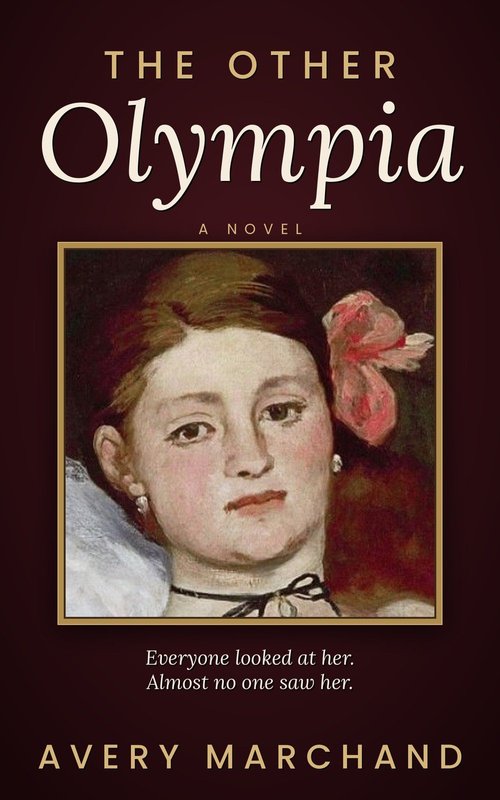
The Other Olympia
A stolen painting, a forgotten woman, and the man on the bench by the parrot.
Brooklyn, December 3rd, 1863
My dearest Édouard,
The weeks since we parted have been the longest of my life. The crossing was cruel. With every wave that struck the bow I felt my heart strike with it, and every league of grey water between us I counted as a debt someone will one day be made to pay. To those who would keep us apart, I wish them a long life, so that they may live long enough to be sorry.
The gift you gave me has not left my body, nor will it. I touch it in the dark as if it were your hand. Everything I have attempted without you has failed, and I fear I shall not be myself again until I am with you. I have been driven away, and yet I am not alone. You know what I mean by that, and you know why I may not write it plainly.
Until we meet again, my love, look upon your creation, and you will forever see me.
Your truest love,
Victoria
The Bench Guy
The first time Rachel saw him, she thought he was asleep.
It was the first Sunday in September, the day before Labor Day, a little after two, and the Met was full of people who had come in out of the heat to stand in front of things. She went every Sunday that fall. She told her advisor it was for the thesis, which was true, and told Simone it was for the air conditioning, which was also true. She took the train up from Brooklyn after a late breakfast and went up the grand staircase to the two small rooms where the Met kept its Manets. She stayed until five. Then she took the R down to Bay Ridge for dinner at her grandmother’s, and Ruth would ask, “Did you see her?” and Rachel would say, “I saw her,” and that would be the end of it.
The second room was the one she wanted. It held the two paintings that had been the first chapter of her thesis and were now, three drafts later, the last: Mademoiselle V. in the Costume of an Espada, a girl of eighteen in a bullfighter’s suit with a pink cape over her arm and a look that dared you to say something about it; and Young Lady in 1866, the same girl four years older, in a pink silk dressing gown, with a parrot on a perch beside her and a violet held up to her face. Victorine Meurent, twice. Rachel had stood in front of the second one on every birthday of her childhood, with her grandmother on the bench behind her. She’d never sat on the bench herself. It was where you sat if you were tired, or old, or had come with somebody who was looking.
That Sunday there was a man on it.
He sat at the left end, with his back straight and a museum map open on his knee, and he didn’t move. Not when a child dropped a juice box and the guard came over to frown at it. His head was bent over the map, his hair was too long at the collar, and he wore a dark wool coat on a day when it was eighty-four degrees on Fifth Avenue. Rachel worked in front of the parrot for forty minutes with her notebook against her chest, and in forty minutes he turned the map over once.
He’s asleep, she thought. He’s found the one cool bench in New York and he’s asleep with his eyes open.
When she left he was still there.
The next Sunday he was there again. Same end of the bench, same coat, same map.
The Sunday after that, she was looking for him before she reached the door.
She didn’t think much of it. People had rituals. An old man in the arms and armor rooms talked to the horses. A man on a bench in the Manet rooms was not a mystery. He was somebody else’s Sunday.
But he read the map. Every week, the whole time, as if it were the last letter someone had ever written him. And he never once looked at the paintings.
So, without quite deciding to, she made him up.
He was a widower. His wife had loved Manet, and he came every week to sit where she’d sat and couldn’t bring himself to look at what she’d looked at. That lasted one Sunday. Then he was a man keeping a promise — he’d sworn to someone on a deathbed that he would come, and he’d never sworn to enjoy it. Then, on a Sunday when the guards were changing and he lifted his eyes to watch them go, he was a spy, and the map was a code, and somewhere in the European paintings a woman in a raincoat was waiting for him to fold it in thirds. Rachel liked that one. She kept it a week. Then, the last Sunday in September, he was a dentist, hiding from his patients. She couldn’t have said why. It was something about his hands.
They were good hands. Long, still, careful with the paper. She noticed them as she noticed hands in paintings, which is to say she couldn’t stop.
She didn’t look at him much. That was part of the game. She’d stand in front of Young Lady in 1866, a little to the right so she wasn’t between him and the wall, and work, and every twenty minutes or so she’d let her eyes slide sideways to the bench. Once, maybe twice, she thought he’d lifted his head a moment before she looked, and she felt her face go warm and bent over her notebook and wrote the word violet three times.
And then, that same Sunday, she caught him.
She’d gone out to the long gallery to look at the Courbets, because she was stuck on a sentence and Courbet was good for being stuck. When she came back to the doorway of the second room she stopped. The man on the bench had put the map down.
It lay folded on his knee. He wasn’t looking at it. He was looking up, at the Espada — not at the costume, which was what everybody looked at; not at the absurd tiny bull in the background, which was what the clever people looked at, so they could say something about the perspective. He was looking at her face. At Victorine’s face. Steadily, as if she’d told him something he didn’t want to hear and he was waiting for her to take it back.
He looked, and went on looking. Then something went across his face, too fast to name, and he picked the map up again.
Rachel stood in the doorway and didn’t move.
Almost nobody did that. She’d spent two years trying to make people do it — her seminar, her mother, the boy at the Pratt bookstore who’d asked what her thesis was about and regretted it. Look at her face. She’d said it so often it had stopped sounding like words. And here was a stranger in a winter coat in September, who didn’t know anybody was watching, doing it on his own.
She went back to the parrot. She didn’t look at the bench again that day. She could feel exactly where it was.
“You’ve built a whole man,” said Simone, “out of a bench.”
They were on Simone’s couch in Bushwick that Thursday with the Sichuan takeout open on the coffee table and Brenda the cat on the edge of it like a customs officer, watching the dumplings go by. Simone was in her dispatch fleece, headset slung around her neck, because she was on the overnight.
They had been friends since the tenth grade at Midwood, since the week Ruth gave Rachel the Victorine biography and Rachel made the mistake of reading it at lunch. A boy named Kevin Daley took it off her tray and walked it around the cafeteria open to Olympia, and the whole room looked at the naked woman and laughed, and Rachel sat with her face on fire and did nothing. A junior she knew only by sight, a girl from two streets over whose mother bought hair oil from Rachel’s mother, got up from the next table, took the book out of Kevin Daley’s hands without a word, and didn’t give it back to Rachel right away. She sat down across from her with it.
“So who is she?” said Simone Baptiste. “Read me the good part.”
Nobody had ever asked Rachel to explain a painting before. She read her the good part. She had been reading her the good parts for eleven years.
“I haven’t built anything. I’ve observed.”
“You’ve given him a dead wife.”
“That was one week.”
“And a dentistry practice.”
“That was a joke.”
“Rach.” Simone pointed a chopstick at her. “You have spent four Sundays watching a man read a map. You know which end of the bench he likes. You know he’s got nice hands. That’s not observation. In my line of work that’s what we call a pattern, and the next call is usually from him, about you.”
“He doesn’t know I exist.”
“Everybody knows when they’re being looked at. It’s the one thing everybody knows.” Simone stole the last scallion pancake. “What do you think he is? Honestly. No spies.”
Rachel thought about the face. About how he’d put the map down when he thought no one could see.
“I think he’s somebody who came to look at something,” she said, “and can’t.”
Simone chewed.
“That,” she said, “is the most dangerous sentence a woman has ever said to me, and I took a call last month from a lady who was trying to get a raccoon out of her dryer with a lit candle.”
“It’s not a sentence. It’s a hypothesis.”
“It’s a man. You’ve built a hypothesis with a jaw.” Simone wiped her fingers. “Fine. Sunday. I’m coming.”
“You hate museums.”
“I hate museums. I love you. And I want to see the bench guy.” She stood up and stuffed the headset in her bag. “If he’s a dentist I’m getting a cleaning out of it.”
So on the first Sunday in October, Simone came.
It was cooler, finally, and Simone complained across the park and up the stairs, about the price of the coffee cart, the number of naked people, and the fact that every one of them was white, which Rachel conceded. They came into the second room at two in the afternoon. Rachel didn’t look at the bench. She knew without looking.
She went and stood in front of the parrot. Simone stood beside her, hands in her jacket pockets, and gave Young Lady in 1866 the look she gave callers who said they were fine.
“Okay,” Simone said. “Pink robe. Bird. I see it. Can we get lunch?”
“Look at her face, Simone.”
“I’m looking.”
“You’re not. Everybody looks at the robe.”
Rachel heard her own voice, and heard her mother in it. It always happened when she cared about something: the Brooklyn went out of the vowels and Port of Spain came in under them, the music she’d learned on a cushion between her mother’s knees. She didn’t smooth it out. That was the thing she would think about later, on the R train, with her forehead against the window: that she’d known exactly how far away the bench was. Six feet. That she’d stepped closer to the canvas, close enough that the guard shifted his weight, and given the speech she had given in her head a thousand times and out loud to almost nobody.
“That’s Victorine Meurent. Same woman as the bullfighter, same woman as Olympia. Everybody thinks they know her because they’ve seen her with her clothes off. She was a painter. She got into the Salon the year they turned Manet down. Nobody remembers that. They remember the body.” She nodded at the painting. “Look how she looks back at you. She isn’t posing. She’s checking.”
Simone gave her a sidelong look. “Is this the thesis voice?”
“This is the thesis.” Rachel laughed at herself; she could feel her ears going hot. “Two years on her, and I’ve never seen the real one. Olympia. Not properly. I’ve never been to Paris. I write about a woman who spent her whole life there and I’ve never even been.”
She didn’t look at the bench. Not once. She looked at Victorine, who was looking back at her over the violet with that level, faintly amused expression, as if she knew exactly what Rachel was doing and was too polite to say so.
Behind her there was the sound of a page not turning.
He’d heard. Whatever he was, widower or spy or a dentist on the run, the man on the bench had heard every word, and he had not turned his head, and she had not turned hers, and it was the most intimate thing that had happened to her in a year.
“Lunch,” Simone said. “I’m begging you.”
“Lunch,” Rachel agreed.
In the doorway, Simone glanced back at the bench, then at Rachel, and raised her eyebrows a quarter of an inch. Him?
Rachel didn’t answer. She walked out with her chin up and her heart going, and down in the café she talked for forty minutes straight — about Professor Hale and her rent and the radiator that only worked on alternate days, about Ruth in Bay Ridge, who would ask her tonight, as always, Did you see her? About the dating app Simone had dared her onto in August, which she’d opened every night since at eleven, in bed, like a cigarette, and which had so far produced a man who wanted to know her shoe size and a sweet veterinarian who lived in New Jersey.
“He’s cute, though,” Simone said. “The bench guy. In a sad way.”
“I didn’t notice.”
“You noticed so hard you couldn’t look at him. I’ve seen you do it to guys since tenth grade.” Simone sipped her iced tea. “Next week, you say hello.”
The next week, the bench was empty.
So were the two after that. Rachel stood in front of the parrot for an hour each Sunday, and didn’t look at the bench more than every few minutes, and at five she took the R to Bay Ridge, and Ruth said, “Did you see her?” and from the cage by the window Harold said it after her, a beat late, in her exact voice — See her? — and Rachel said, “I saw her.” She didn’t say that she’d been, for three Sundays, slightly heartbroken over a man she’d never spoken to, the way you can be heartbroken over a house you used to pass on the way to school when they paint it a different color.
You built a whole man out of a bench, she told herself. And then somebody came and took the bench.
On a Tuesday in late October, at eleven at night, she was in bed with her phone, the radiator clanking, and opened Hereabout as she always did, without expectation.
Two new messages. One from the veterinarian, who was getting back together with his ex and wanted her to know it wasn’t her. One from a man whose profile picture was a fish.
Then the stack of faces, nearest first, each with its grey line of distance underneath. 2 miles away. 1 mile away. Less than a mile away. She thumbed through them the way you go through other people’s mail. A beard. A boat. A beard on a boat. And then a card that hadn’t been there the night before, where the prompt Together, we could had been answered:
You may have won a free trip to Paris! Message me for details.
Rachel snorted.
Everybody knew what that was. Her mother had once lost a hundred and twenty dollars to a pop-up like it that promised a free weekend in Atlantic City, and her father had never let her forget it. Rachel had a rule, a family rule: you do not answer the prize. There is no trip. There is a man in a basement in Lagos or Minsk or Tampa who wants your Social Security number, and the trip is the hook he puts it on.
Her thumb was already moving to send it left when she saw the photograph.
A man on the Brooklyn Bridge, in sunglasses, with the wind blowing his hair across his forehead. He was looking off to the left, toward the harbor, his head tilted forward and to one side. Daniel, 34. Less than a mile away.
Rachel stopped breathing.
She spread her fingers on the glass. The face went grainy. She didn’t need it not to be grainy. She knew that jaw. She knew the line of it from the side, from four Sundays at an angle of about forty degrees. She knew the way he held his head, as if it were heavier than it should have been. She’d have known him from the back.
She read the rest of it.
I have an extra ticket to Paris in the middle of next month and I don’t want to go alone.
Then she turned the phone face down on the duvet and lay with her hand flat on it, as if something might get out.
Paris.
It was a scam. Of course it was a scam. A real man didn’t write his dating profile like a cruise line. A real man didn’t need to. And the photograph was stolen — it had to be — scraped off somebody’s vacation album by a man in a basement who’d needed a face that looked sad and trustworthy and a little expensive.
She turned the phone over, saved the picture, and ran it through a reverse image search. Nothing. No vacation album, no stock site, no Swedish model with a different name. The photograph existed in exactly one place in the world, and that place was less than a mile from her bed.
So either a man in a basement had happened, out of the eight million faces in New York, to pick the one she’d spent September inventing, or he hadn’t. And Rachel didn’t like coincidences. She was writing a thesis against one: the coincidence that the same woman happened to appear in ten of Manet’s paintings, and happened to be forgotten, and happened to have been, all along, a painter. It wasn’t a coincidence. It was a reason nobody had bothered to find.
Okay, she thought. So find it.
The message box had a blinking line in it, waiting. She knew what she was supposed to write. Tell me more. What’s the catch. Is this real. Anyone could answer those. The man in the basement had the answers printed out and taped to his monitor. She needed a question only one person on earth could answer.
Her heart was going so hard she could hear it over the radiator.
Then she typed:
What were you reading on the bench by the parrot?
It was the most ridiculous sentence she had ever written, and she’d once written fourteen pages on the semiotics of a hat.
At 11:14 she pressed send.
Then she put the phone on the pillow and lay back and looked at the ceiling, where a water stain shaped like Ohio had been spreading since August, and told herself that nothing would happen. If he was a bot, nothing would happen. If he was a scammer with a stolen face, he’d write back something warm and vague about destiny, and she’d delete her account, and Simone would laugh so hard she’d have to put the phone down. If he was a stranger who happened to look like the bench guy, he’d write back what parrot? and she’d die, quietly, of shame, and they’d find her in the spring.
At 11:25 the phone buzzed against her ear.
She didn’t move for a second. Then she rolled over and looked.
Three words. No greeting. No name.
A terrible map.
Rachel sat up in bed. She read it again. She put her hand over her mouth, and under her hand she was smiling, which she would never tell anybody, and she was also afraid, which she would tell Simone first thing in the morning, in detail.
So he was real. The bench was real. The map was real. And now he was within a mile of her, offering her Paris.
It could still be a scam. It was probably still a scam. A man could be real and a scam at the same time; she’d dated two of them.
But it was a specific scam now. It had a face and a bench and a sense of humor. It could be looked at. And Rachel had spent her whole life learning to look at things.
She went to the window and looked down at Clinton Avenue. A cab. A man with a dog. Nobody on a bench.
“Okay, bench guy,” she said out loud, to the empty room. “Let’s see what kind of scam you are.”