The real Victorine
She was sixteen when she started modeling in Thomas Couture's studio in Paris. Her name was Victorine-Louise Meurent, born February 18, 1844.
In 1862 she posed for Édouard Manet for the first time, as The Street Singer. Over the next eleven years she became his favorite model: a bullfighter in Mademoiselle V. in the Costume of an Espada, the woman on the grass in Le Déjeuner sur l'herbe, and in 1863 the woman on the bed in Olympia. When Olympia was shown in 1865, it caused an uproar. Paris knew her face. Almost no one knew her name.
Her last appearance for Manet was The Railway, in 1873. By then she wanted something else. She took art classes, then studied with the portrait painter Étienne Leroy, and Manet, who disliked the academic style she was learning, drifted away.
In 1876 the Paris Salon accepted her painting. That same year, it rejected Manet's. She showed at the Salon again in 1879, with Bourgeoise de Nuremberg au XVIe siècle, and in later years as well. In 1903 she joined the Société des Artistes Français.
Most of her work is lost. One painting, Palm Sunday, surfaced in 2004 and now hangs in the town museum of Colombes, outside Paris.
She spent her last decades in Colombes, in a house she owned with her companion, Marie Dufour. In the 1921 census, at seventy-seven, she still gave her profession as artist. She died on March 17, 1927.
For a long time, the story told about her was a sad one, of a model who faded. The record tells a different story: a woman who wanted to paint, and did.
The Other Olympia is fiction. Victoria, the painter at its heart, is invented. But she began with Victorine.
The two at the Met
Gallery 810, The Metropolitan Museum of Art. They hang side by side, and The Other Olympia keeps going back to them.
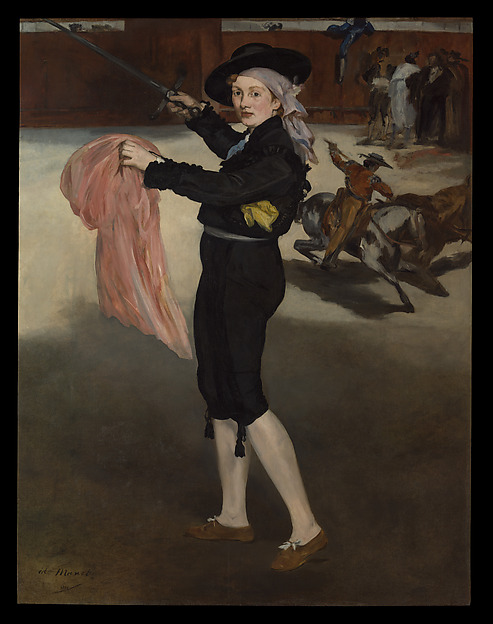
Mademoiselle V. in the Costume of an Espada
- She is about eighteen, dressed as a matador. The V. in the title is the only part of her name Manet gave the public.
- The pink cape and the sword: a matador’s tools, in a young woman’s hands. That was the provocation.
- The bullfight behind her. It is far too small for the space and was painted from prints, not life. Manet had not been to Spain yet.
- Her face. It is the same direct, unbothered look she gives the viewer in Olympia a year later.
- It was shown at the Salon des Refusés in 1863, beside Le Déjeuner sur l’herbe, so the crowd met her twice in one room.

Young Lady in 1866
- Four years on, nearly life-size, in a pink silk dressing gown. Often called Woman with a Parrot.
- The violets she holds to her face, and the man’s monocle on a ribbon that she fingers with her other hand.
- The grey parrot on its perch, and the half-peeled orange on the floor below it. Some read the picture as the five senses: smell, sight, hearing, taste and touch.
- It answers Courbet’s nude Woman with a Parrot, also at the Met. Manet kept his model dressed.
- The Met was given it in 1889, with Manet’s Boy with a Sword. They were among the first Manets any museum owned.
The Met Fifth Avenue, second floor, European Paintings. The two hang together in Gallery 810 at the time of writing; galleries change, so check the Met’s collection pages (linked from each picture) before you go.
The other portraits
From Paris to Boston to Washington. These are the ones the novel mentions, or that are easy to visit.
Olympia
The one everyone knows. Explore it detail by detail, including the pearl in her ear, on our Olympia page.
Musée d’Orsay · Paris 1863Le Déjeuner sur l’herbe
Nude on the grass between two dressed men, looking straight out at you. The scandal of the Salon des Refusés.
Musée d’Orsay · Paris c. 1862Victorine Meurent
A small head-and-shoulders portrait, probably the first time Manet painted her. Blue ribbon, red hair, eighteen.
Museum of Fine Arts · Boston c. 1862The Street Singer
Stepping out of a café with a guitar under her arm and a handful of cherries at her mouth.
Museum of Fine Arts · Boston 1873The Railway
Older now, a book and a puppy in her lap, a child beside her watching the steam. The last time she sat for Manet.
National Gallery of Art · WashingtonTwo of hers you can see
Most of her paintings are lost. These two survive.
Self-Portrait
Painted around the year the Salon accepted her and turned Manet down. Boston’s Museum of Fine Arts acquired it in 2021.
Museum of Fine Arts · BostonPalm Sunday
Shown at the Salon of 1885, lost for more than a century, and rediscovered in 2004. It hangs in the town where she spent her last years.
Musée d’art et d’histoire · Colombes