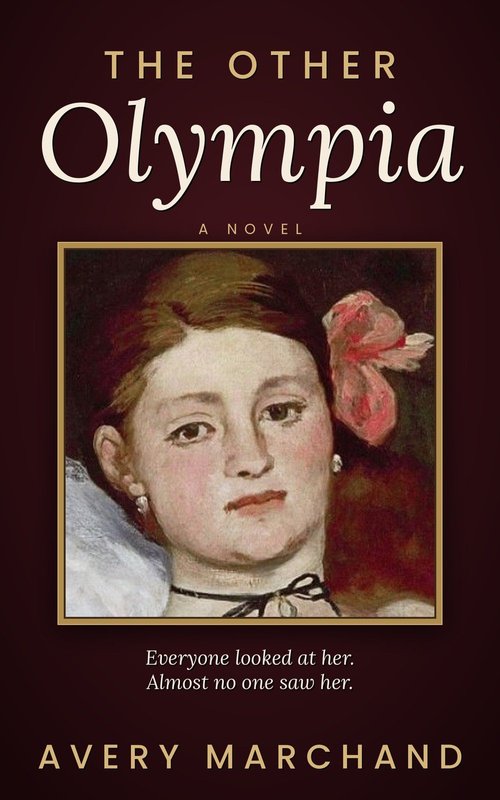
The Other Olympia
Chapter Two: the other side of the bench.
Free Trip to Paris
I’d known her name for four months before she told it to me.
Nothing else would be worth much if I started with a lie. I’ve told enough of those. Most of this story is about them.
I wrote the profile on a Tuesday night in October, at the desk in my apartment in Sunnyside, with the 7 train screaming past the window every four minutes like it was late for something. I had cold coffee and two airline tickets on the desk, printed, because I’ve never trusted anything I can’t fold and put in a pocket.
The app was called Hereabout. It asked me my age, which was thirty-four; my relationship status, which was complicated in a way no dropdown menu could hold; and what I was looking for, which was a woman named Rachel Novak who didn’t know my name. Then it gave me prompts to finish. I picked Together, we could and wrote:
You may have won a free trip to Paris! Message me for details.
It looked like spam. That was the point. Nobody sensible answers spam, and I didn’t want somebody who answered. I wanted somebody who’d look at it and see something she recognized.
Under it I wrote: I have an extra ticket to Paris in the middle of next month and I don’t want to go alone. I added a photograph a stranger had taken of me on the Brooklyn Bridge a year before, in sunglasses, with the wind in my hair, looking off to one side — enough of a face to be wanted, not enough of one to be found. Then I took the G to Clinton-Washington, walked up into Fort Greene Park, and sat on a bench under a lamp with the phone in my lap, and at 10:52 p.m. I made the profile live. That was eight minutes before she usually opened the app, and a little under half a mile from her bed.
I knew about eleven o’clock because I had heard her say so. I knew about the half mile because I had made it my business.
The messages came the way water comes through a bad roof. Women within a mile who wanted to tell me I was a creep, in paragraphs. At 11:14 her picture came up and the lump in my throat let go so suddenly I made a sound in the dark.
Copper-brown curls, cut to the jaw. Green eyes in a warm brown face. A smile that was trying not to be one.
Her message said: What were you reading on the bench by the parrot?
I let it sit on the screen. You don’t answer the first message in the first minute.
I’d built the whole profile around the hope that she’d look at that photograph and know me, and here it was. It still went through me like cold water. She hadn’t asked what the catch was. She hadn’t asked if I was real. She’d asked the one question nobody else on earth could answer, and the question under it was: I know who you are. Do you?
It took me ten minutes to type three words. I deleted them twice.
A terrible map.
We wrote for four days. I gave her my name — Daniel Phillip, no s, which was true — and she gave me hers, which I pretended to learn. On the second night I asked, as if it were a joke, whether she even owned a passport. Montreal counts, she wrote. Barely. It’s good till 2031. On Saturday night she wrote: Coffee. Daylight. Public. My choice of place. I said yes to all four.
We met on Sunday at a coffee place on Atlantic Avenue that had been a hardware store once. I was early. I’m always early. I bought two cappuccinos and took the small table by the brick wall where I could see the door and she would have to cross the room to reach me, which would give me time to look at her and her time to change her mind.
I didn’t want her to change her mind.
She came in at three minutes past ten in black tights and wool-lined boots, a purple scarf looped twice around her throat, her hair pinned up in a way that suggested she’d done it on the train. When she found me she hesitated for half a second — I saw her measure the distance to the door — and then she came over, put her bag on the floor between her feet, and held out her hand.
“Hi. I’m Rachel.”
“Daniel.” I shook it. “I didn’t know what you drank, so I guessed.”
She looked at the cappuccino, and then at me, and then back at the cappuccino.
“You didn’t put anything in it?”
“Not yet,” I said, and when her eyebrows went up I said, “No. God, no. But good for you for asking.”
“My friend Simone made me promise to ask.” She lifted it, sniffed it with great ceremony, and drank. “She also made me promise to share my location with her and to say the word ‘pineapple’ if I need her to come and get me.”
“Is that the word?”
“That’s the word.” She smiled then, the full version. “You look less like a serial killer without the sunglasses, if it helps.”
“What do they look like?”
“Usually more confident.”
I laughed, and it wasn’t a performance, and that was the first crack in the plan. A hairline fracture in a cup: not enough to throw it away. Not yet.
She didn’t laugh with me. She set the cup down and put both hands on the table.
“So here’s my problem,” she said. “I don’t believe in coincidences. I spent four Sundays in September looking at a man on a bench who never looked at anything but a museum map. Then the bench was empty. Then the man turns up on my phone at eleven at night, less than a mile from my bed, offering me Paris like a cruise to Aruba.” She tilted her head. “So you tell me. What is this?”
There are moments when a lie is the obvious move and the truth is the better one. I’d learned that from my grandfather, who’d learned it on Forty-Seventh Street, where every man you sell to has a loupe.
“I go to the Met to think,” I said. “My grandfather was obsessed with Manet. I sat there most of September because it was the last place I could stand to be. I saw you. In October, with your friend. I heard you tell her to look at the face.”
“Everyone in the room heard me.”
“Everyone in the room didn’t put the map down.”
She looked at me and waited.
“And the profile? Less than a mile, Daniel.”
“I walk at night,” I said. “Fort Greene, mostly. I don’t sleep well.” I turned my cup on the saucer. “The profile was for anyone who’d answer it. The photograph is the only one I’ve got that I don’t hate. I didn’t think anyone would know it was me.”
One of those three things was true.
“Hm,” she said. It wasn’t agreement. It was a note filed.
“Can I ask you something?” I said. “Why’d you answer? You must have known it looked like a scam.”
“It is a scam.” She said it pleasantly. “I just wanted to see what kind.” She folded her hands on the table like a schoolgirl. “Okay. Details. What’s the catch with Paris?”
I told her I’d booked a trip for two — flight, hotel, a pass for the museums — for my girlfriend’s birthday, and that a week before I’d learned she’d been seeing someone else, an old boyfriend. I told her it was all nonrefundable. I told her I didn’t want to go alone and I didn’t want to go with a friend, because going with a friend would make it a consolation prize, and I wanted it to be — I looked for the word — “an adventure. Not a wake.”
“That’s awful,” she said, and she meant it. Her hand moved across the table and touched the back of mine, lightly, then retreated. “How long were you together?”
“Almost three years.”
“I’m sorry.” She took her phone out of her bag. “What’s the booking reference?”
I blinked. “What?”
“The flight. You said it’s booked. Booking references are six letters. What’s yours?”
I took the printout from my coat and read it to her. She wrote it on a napkin. Then she dialed the airline, right there at the table, put it on speaker, and we sat for nine minutes listening to hold music on what sounded like a pan flute, while she drank her cappuccino and watched my face.
“I had the name changed on Thursday,” I said, into the pan flute. “After you told me your last name. It’s a hundred and fifty dollars to change a name. I took a chance.”
“Mm-hm.”
A woman came on the line. Rachel gave her the reference, spelled her name, and asked if the booking was confirmed. It was. First class, JFK to Charles de Gaulle, Saturday the fourteenth of November, one passenger: Novak, Rachel, Ms. She thanked her, hung up, and put the phone face down on the napkin.
“First class,” she said.
“It was for a birthday.”
“It’s in my name.”
“I told you. Thursday.”
The ticket had been in her name for nine days. I didn’t tell her that. Or that it was one of two bookings, made in the same minute from my laptop and my phone, seats 2A and 2B, so that anything she called about would only ever show her name.
“What did your grandfather do?” she said. “The one with the Manet obsession.”
“He was a setter. Diamonds. Thirty years on Forty-Seventh Street. They called him the Swede.”
“Is he still alive?”
“No. Four years.”
She nodded, as if putting that somewhere, too. That Thursday, on a bench in Fort Greene Park, she told me she’d gone up to Forty-Seventh Street that morning and asked at the counters until a man in a back booth with a loupe on a string looked at her over it and said, The Swede? Gustav. Good hands. Dead four years. He had a grandson, quiet boy. She told me this like a confession. I told her I was flattered. It checked out. Of course it did. It was true.
“One more,” she said at the table that first morning. “I looked you up. Before I came.”
“I’d hope so.”
“There’s nothing. Not a Facebook, not a LinkedIn, not a photograph except the one on the app. There are a dozen Daniel Phillips in the world and you’re not any of them.” She leaned back. “You’re either private or fake.”
“Private,” I said.
It was the truest thing I’d said all morning, and the best weapon I had. The trip was real. The tickets were real. The grandfather was real, and the Sundays on the bench. There had never been a girlfriend. A con that’s ninety percent true passes every test a smart person runs, and she was the smartest person I’d sat across from in years, and she’d run every one.
Her phone buzzed on the napkin. She turned it over, typed one word, turned it back.
“That was Simone. I told her ‘mango.’”
“Is that good?”
“It means stay.” She folded her arms on the table. “Look. I’m in the second year of a master’s at Pratt. I’m writing my thesis on a woman who spent her whole life in Paris and I have never been, because I have nine hundred dollars in my checking account and a stipend that doesn’t cover my rent, and I’d still rather be broke on Clinton Avenue than twenty-six in my old room over my mother’s salon. I am not going to sleep with you for a plane ticket.”
“That’s fair.”
“But I will hold your hand on the Pont des Arts and tell the waiters I’m your girlfriend, and if it turns out I like you —” She tipped her head. “Then it turns out I like you. That’s the best I can offer.”
“That’s more than fair.”
“Good.” She picked up her cup. “You already know who I’m writing about. You heard the speech.”
“Victorine Meurent.”
She found a picture on her phone and turned it to me. The white bed, the black ribbon, the eyes. “Manet’s favorite model. The famous nude.”
“So she was his muse.”
“She was a painter.” She put the phone face down. “She showed at the Salon. Her own pictures, with her own name on them. She outlived him by forty-four years. The art world turned her into a scandal and then forgot her name. I’m trying to give it back.”
I looked at her and thought: you have no idea how close you are.
“I’d like to hear about her,” I said. “In Paris.”
We saw each other most days after that.
I’d wait for her outside the gates on DeKalb Avenue when her seminar let out, and we’d walk until we found somewhere to eat or sit, and she’d talk. She talked about everything — about growing up in Flatbush, about her mother, who did hair in a salon on Church Avenue and still phoned her own mother in Port of Spain on Sunday nights to argue about pelau, about the professor who called her thesis “sentimental” and the moment she decided to prove him wrong. I listened. I’m good at listening. It’s most of what I’m good at.
She asked about me, and I gave her a version of myself sanded smooth. I told her I lived off investments my grandfather made, and that there wasn’t much left of them, and that I was between things, which is what people say when they don’t want you to ask what things.
“What do you do on Saturdays?” she asked once. “You’re never free on Saturdays.”
“My grandfather’s friend,” I said. “In Rockaway. I play chess with him. He always loses.” It came out easily.
The first cold night came in the first week of November, a wind straight down Lafayette Avenue that went right through my coat. She’d worn her good purple scarf, the thin one, for looks. Halfway down the block she reached up without asking and unwound mine — grey, wool, my grandfather’s — and wound it twice around her throat over the purple one, and tucked her chin into it.
“That’s mine,” I said.
“It was.” She walked on. “Possession is nine-tenths of the law. I read that somewhere. Maybe on a bench.”
I never got it back. I didn’t ask. She wore it every night after that, the purple under the grey.
She took my arm on every walk. Not my hand — my arm, the old-fashioned way, her hand through the crook of my elbow. When it got colder she stopped bothering with the elbow and pushed her hands into the pockets of my coat, in with mine, so that we went down Clinton Avenue joined at the hip, and she’d say your pockets are warmer than mine, it’s a design flaw in women’s coats, and I’d say nothing, because in the right-hand pocket was a black notebook the size of a passport, with forty pages of my plan in it. On the second night I moved it to the inside pocket.
“What do you want to do?” she asked another time, in Fort Greene Park, with the leaves coming down around us.
“Finish something,” I said.
“Finish what?”
“Something my family started.”
She waited for more. I let the silence sit until she took it as sadness and leaned her shoulder into mine, and I let her think that, because it wasn’t untrue.
She was falling for me. I could see it. I didn’t stop it.
One night in early November I walked her home to Clinton Avenue, to the brownstone where she rented the top floor from a retired cantor and his wife. We stood on the stoop under the yellow porch light. She turned to me with her keys in her hand and didn’t put them in the lock.
She leaned in. Just slightly. Just enough.
And I wanted to. I wanted to kiss her more than I’d wanted anything in a long time, and I didn’t, because I knew what I was going to do to her, starting in eleven days, and there was a limit — there turned out to be exactly one limit — to what I could take from her before then.
I touched her cheek instead. I said goodnight.
I watched the disappointment cross her face and settle, then watched her choose to be gracious about it.
“Eleven days,” she said, at the door. “I’m going to Paris in eleven days.”
“I know,” I said.
After that she teased me. Every night on the stoop, when I didn’t, she’d stand on the second step with my scarf up to her nose and say something. Coward. Or, Is it my breath? You can tell me. Simone would tell me. Or once, seriously, with her hand on my lapel: “You’re allowed, you know. I checked.”
“Checked with whom?”
“The cantor. His wife. The man at the deli.” She let go of my lapel. “You’re running out of excuses, bench guy.”
The night after that, at the Clinton-Washington station, where she was seeing me onto the G because it was raining, she leaned across the turnstile as I pushed through it and kissed me on the cheek, quickly, below the eye, and stepped back.
“There,” she said. “Somebody has to go first.”
The turnstile clunked shut between us. She waved through the bars. I walked down to the platform with my hand on my face where she’d kissed it, like a boy, and when the train came I took the notebook out of my inside pocket, the one with the plan in my grandfather’s cipher, and looked at it without reading a word.